
For most parents, school budgeting begins and ends with tuition fees. But as any seasoned parent knows, tuition is just the entry price. The real strain on a family budget comes from the "hidden" school economy: the mid-term field trips, the sudden uniform replacements, the annual day costumes, and the extracurricular supplies that seem to appear out of nowhere.
In the Lab, we treat the school year not as a fixed expense, but as a series of financial seasons. By moving from a "reactive" to a "proactive" school budget, you can eliminate the stress of the Sunday night "I need money for school tomorrow" surprise.
Beyond Tuition: Identifying the Hidden Costs
The first step in the playbook is acknowledging the expenses that do not show up on the official fee bill. These are the "stealth" costs that often lead to Family Money Lesson (FML) moments:
The Uniform Growth Spurt: Children rarely wait for the end of the academic year to outgrow their shoes or blazers.
The Activity Creep: Sports gear, musical instrument maintenance, and club fees often accrue mid-semester.
The Social Calendar: Birthday party gifts for classmates and "teacher appreciation" collections.
Project Supplies: The 9:00 PM realization that a science project requires specialized materials by morning.
The Sinking Fund Strategy
Instead of paying for these out of your monthly "Life Bucket," we recommend creating a School Sinking Fund.
A sinking fund is a dedicated savings pot where you accumulate small amounts monthly to pay for large, known expenses later. If you know you spend 12,000 Rupees a year on uniforms and trips, saving 1,000 Rupees a month makes these costs invisible when they finally arrive.
Planning the Academic Seasons
The school year has high-spend and low-spend seasons.
The Peak (June/July or August/September): This is the "Big Buy" season—books, stationery, and primary uniforms.
The Mid-Season (October to March): This is the season of "Events"—annual days, sports meets, and field trips.
The Reset (April to May): Use this time to audit what can be reused next year, saving you from overbuying during the peak season.
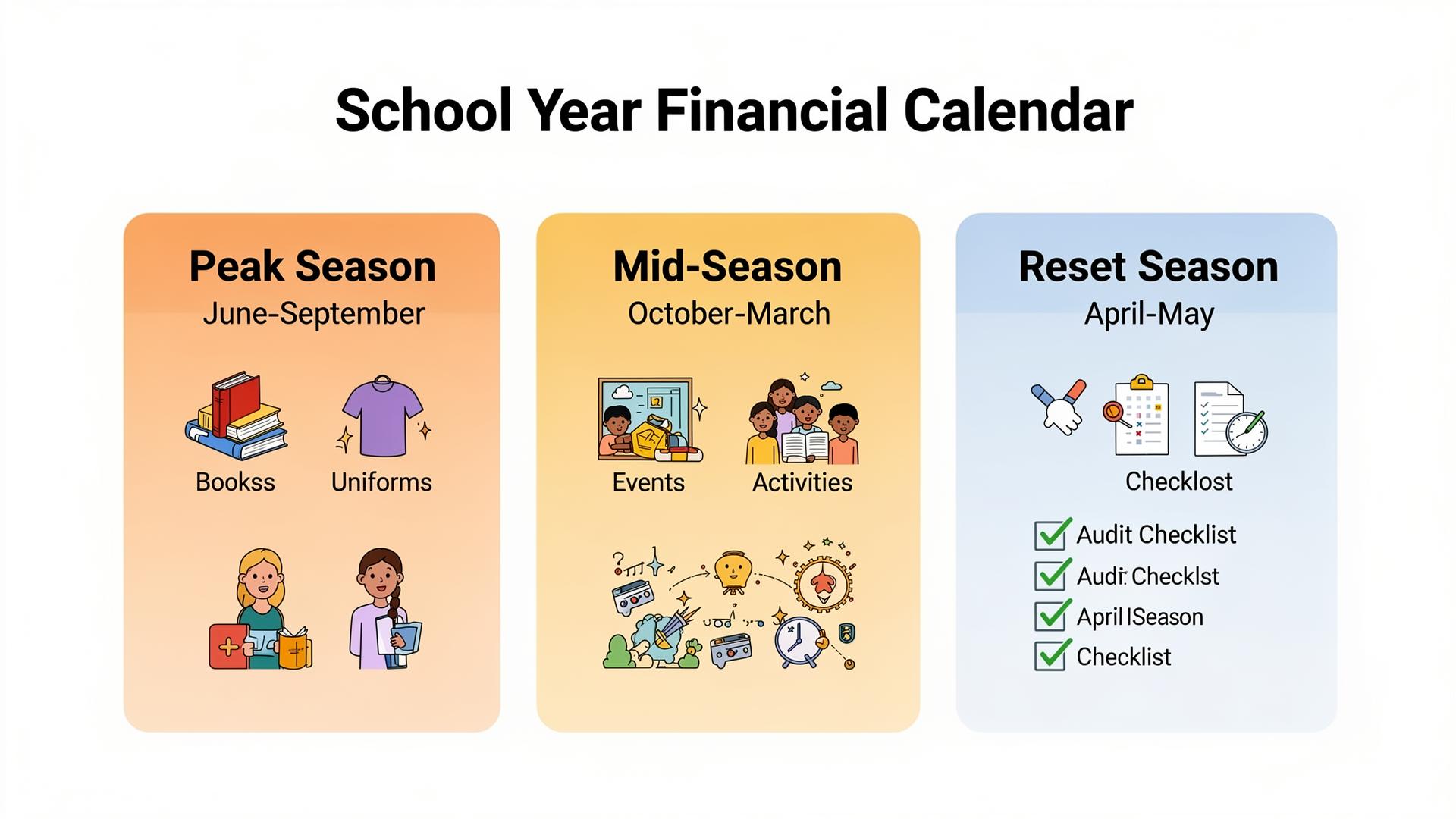
The School Year Financial Calendar: Plan your spending around academic seasons
Real Family Money Lesson: The Last-Minute Costume
A parent shared this common struggle: "Last year, I got a notice on a Thursday that my son needed a 'traditional farmer' outfit by Monday. Between work and chores, I ended up buying a ready-made set at a premium price and paying for express delivery. It cost three times what it should have. Now, I keep a 'Costume and Project' box in the house and a small cash buffer specifically for these school alerts."
Global Examples: School Costs Around the World
In India: Parents often face "Activity Fees" that are separate from tuition, alongside significant costs for private coaching or specialized extracurriculars.
In the USA/Canada: "Back to School" shopping is a major retail event, with high costs associated with technology requirements (tablets/laptops) and sports "pay to play" fees.
In the UK/Australia: Uniform requirements are often very strict, meaning parents cannot easily opt for cheaper "unbranded" alternatives for blazers and ties.
Real Story from the Lab
From families just like yours
@Anonymous
Last year, I got a notice on a Thursday that my son needed a "traditional farmer" outfit by Monday. Between work and chores, I ended up buying a ready-made set at a premium price and paying for express delivery. It cost three times what it should have. Now, I keep a "Costume and Project" box in the house and a small cash buffer specifically for these school alerts.
The Family Money Lab
Written by a parent focused on building calm, practical money systems for families. Content is based on real-life experience, research, and behavioural finance principles.
Learn more about us →Disclaimer: This content is educational and based on personal experience. It is not financial advice. Please consult a qualified professional for your specific situation.
This article is part of our comprehensive budgeting guide
Read the Full Family Budgeting Guide